
If you already know Incogni, the question is which service would suit you better. I’d choose Optery for visible removal evidence, DeleteMe for managed help, or EasyOptOuts for a much smaller US budget. Aura and Cloaked make sense when you want protection beyond broker removal.
When you buy through links on our site, we may earn an affiliate commission. Learn more
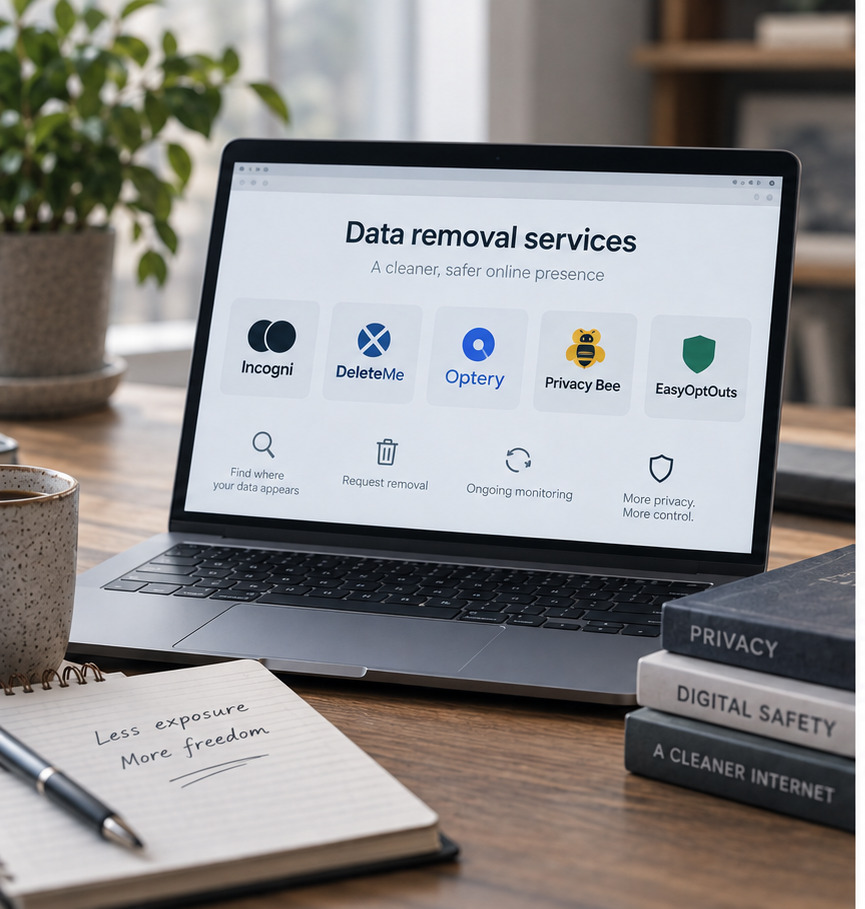
Incogni is a useful baseline: recurring automated broker requests, international availability and custom removals on Unlimited. I’d switch when another service solves a specific problem better, rather than because a competitor advertises a larger total.
The most worthwhile reasons are clearer evidence, more personal help, a lower bill or additional privacy tools. Country support comes first. A US bargain is of little use if you live in the UK and can’t buy the relevant service.
This guide compares direct substitutes and a few specialist options. For the whole category, our Best Data Removal Services guide has the broader shortlist.

My quick answer: Optery for screenshots and a free exposure report; DeleteMe for managed removal; EasyOptOuts for a low US budget; Aura for wider identity protection; Cloaked for masking contact details as well as removing existing records.
I’d keep Incogni if I wanted recurring broker work handled in the UK, or its Unlimited custom-removal workflow suited the exposures I already had. These options earn their place for a different fit, rather than an overall ranking.


I want clearer proof: a screenshot of a relevant listing before and after removal is easier to assess than a combined request total. Optery is the strongest fit here, provided I select the tier that includes its removal reports.
I want more help: managed removal can be worthwhile when the same exposure needs repeated follow-up or I want an analyst to review the case. DeleteMe is my shortlist option for that preference.
I want a smaller bill: US residents with a straightforward people-search problem can consider EasyOptOuts. The savings come with a simpler service and less frequent scanning than some alternatives.
I want wider protection: Aura adds identity monitoring and recovery features; Cloaked adds masked contact details. I’d only pay for those bundles if I will use the extra tools.
I’d start with the reason for switching, then check local coverage and the actual billing term. These are public individual offers checked in October 2026; taxes and checkout offers may vary.
| Service | Why I’d choose it instead | Region fit | Cost and billing | Evidence and ongoing work |
|---|---|---|---|---|
| Optery | Free exposure check; screenshot reports on higher tiers | US; Canada excluding Quebec; Australia; New Zealand; South Africa. No UK personal coverage. | Core $3.99 monthly or $3.25/month billed $39 annually; Extended $14.99 monthly or $12.42/month billed $149 annually | Monthly paid scans; Extended/Ultimate before-and-after reports; Expanded Reach has different verification limits |
| DeleteMe | Managed removal and analyst help | US and supported international markets including UK | US standard $10.75/month, billed $129 annually; UK plan priced separately | Regular privacy reports and repeated removal work; check the regional plan’s scope |
| EasyOptOuts | A much smaller US removal budget | US adults | $19.99 billed annually | Three scan rounds per year; email summaries; no household bundle |
| Aura | Identity monitoring and recovery alongside removal | US eligibility | $12/month, billed $144 annually, or $15 billed monthly for Individual | Automated removal within a wider protection subscription |
| Cloaked | Masked emails and phone numbers alongside removal | US and Canada; feature eligibility varies | Individual $14.99 billed monthly or advertised $9.99/month billed $119.99 annually | Removal plus tools for limiting future disclosure of contact details |
| Incogni baseline | Recurring broker requests with international availability | US, UK and other supported regions | Standard $7.99/month billed $95.88 annually; UK £5.99/month billed £71.88 annually | Request tracking and recurring work; custom requests on Unlimited |
I wouldn’t rank these by headline site counts. Automated coverage, custom requests, private databases and screenshot-verifiable public listings describe different things.
I’d keep Incogni if I wanted recurring broker requests handled across its supported international markets. Standard covers the automated network; Unlimited adds eligible custom removal requests. For UK readers, that local availability and GBP billing are a practical advantage over US-only options.
Standard is $7.99/month billed $95.88 annually in the US, or £5.99/month billed £71.88 annually in the UK. Unlimited is $14.99/month billed $179.88 annually or £10.99/month billed £131.88 annually. Monthly subscriptions are available at higher monthly rates.
I’d switch only when another service addresses a clear priority better. A completed-request total isn’t the same as that many public listings removed, but the recurring work still has value when doing every opt-out yourself has become a burden.
My Incogni Review explains how I checked individual requests and judged the Standard and Unlimited workflows.


I’d choose Aura over a removal-only plan if credit monitoring, identity alerts and recovery assistance are also on my shopping list. Broker opt-outs are useful, but they don’t tell me whether somebody has opened an account in my name or help me recover from that fraud.
The current Individual offer is $12/month, billed $144 annually, or $15 billed monthly. Aura’s removal coverage now includes more than 425 broker sites; Google Search Cleanup and unused-account cleanup are also part of its wider privacy offer. These functions have different limits, so I’d check the specific exposure rather than assume every kind of record can be erased.
I wouldn’t pay for the wider bundle just to get routine broker removal. Aura’s service is built around US eligibility, and its credit and insurance features are especially country-specific. Our Aura Review covers the broader product.
Best fit: an eligible US reader who will use the monitoring and recovery tools as well as removal.
The reason to buy broader protection is that exposure and fraud are different stages of a problem. Broker removal may reduce accessible personal details, but it won’t tell me whether an account has been opened in my name or guide every recovery step after misuse.
Aura fits when eligible monitoring and recovery assistance address those additional concerns. Check which features work in your country, the household coverage and the recovery terms. If an incident is already underway, use the appropriate bank, account and reporting routes immediately as well as considering a subscription.
Masking addresses a different point in the cycle: it can limit the contact details a new business receives, while removal tackles records already circulating. That matters when repeated sign-ups keep feeding the same real email or number into commercial databases.
I’d check how aliases forward messages, what happens if I stop paying and whether critical accounts still need a reliable long-term recovery contact. A masked address won’t hide an address in a public record or erase old broker copies. This is most useful for someone willing to change future sign-up habits alongside the removal work.

I’d shortlist DeleteMe when I want an analyst-backed service and regular reports explaining the work. That is a different priority from keeping the automated subscription bill as low as possible.
The standard US subscription is $10.75/month, billed $129 annually. International plans are separate: the supported markets include the UK, Canada, Australia and selected European countries. I’d compare the local plan’s actual broker list and price, rather than applying US coverage to every reader.
DeleteMe’s privacy reports distinguish exposures reviewed from data found and removal progress. I’d use those distinctions to see whether the sites I care about are being addressed. A managed service still needs accurate profile information and time for brokers to respond.
Best fit: someone willing to spend more for personal assistance and a report-led service. I’d check the applicable local terms before treating it as a like-for-like Incogni replacement.
Human assistance matters most when a record is irregular, keeps returning or needs an explanation that an automatic status doesn’t provide. I’d judge the managed service by whether the report connects an action to the actual exposure and gives me a clear route for a stubborn case.
This suits someone who wants to hand over recurring administration, rather than chase each opt-out. It still needs accurate matching information and an eligible source. Check local broker coverage, the reporting interval and what support does with a persistent address listing before paying the higher annual bill.
The lower price is useful when the problem is a manageable set of US people-search listings and I can accept the maintenance schedule. Three scan rounds a year mean I shouldn’t expect every new listing to trigger immediate action. If an exposure creates an urgent safety concern, I’d pursue that page directly rather than wait for the next round.
I’d verify the particular sites and identifiers covered, the information supplied to brokers and how to handle a record that remains visible. This is a narrower maintenance purchase; the value comes from affordable recurring work rather than buying the same depth of reporting or personal help as a premium tier.

I’d consider Cloaked if my email address and phone number keep reaching companies through new sign-ups. Removing old records helps, while masked contact details can reduce what I disclose next time. I’d use the two approaches together.
Cloaked combines removal with email and phone aliases and other privacy tools. Its current Individual offer is $14.99 billed monthly, or an advertised $9.99/month with $119.99 billed annually. The current help centre lists availability in the US and Canada; individual features and eligibility still need checking.
I’d only choose this over Incogni if I will actually use the masking tools. It brings more habits to maintain, such as choosing an alias for a new account and keeping track of where I used it. Masking can’t erase a historical address record or information already leaked elsewhere.
Best fit: someone who wants to limit future contact-detail exposure as well as clear existing broker records.
I’d put EasyOptOuts ahead of more expensive bundles for a straightforward US people-search problem on a small budget. The current personal subscription is $19.99 billed annually, with three scan rounds a year and email summaries.
That price changes the value comparison. I’d rather buy a simpler service I can afford to maintain than stretch to a large bundle whose extra tools I never use. The pricing and service terms specify the scan frequency and 150-day guarantee.
The trade-off is a less frequent maintenance schedule and a narrower service proposition. It is for adult US residents, with no family bundle or broad international consumer service. I wouldn’t choose it for urgent bespoke takedowns or expect Optery-style screenshot reporting.
Best fit: a US adult who wants low-cost recurring opt-outs and is happy with a straightforward service.

I’d list the exposures I actually want removed, check the service’s local coverage and decide what evidence I want back. Then I’d compare the right tiers: a cheap automated plan and a managed screenshot-report plan are different purchases.
For UK readers, Incogni and DeleteMe deserve the first comparison. Optery’s international expansion doesn’t include UK personal accounts, while Aura and EasyOptOuts are US-focused. For readers elsewhere, I’d use the local plan’s coverage and billing rather than a US headline number.
I’d also check which identifiers can be added, whether custom requests cover my problem and what happens when the subscription ends. Family coverage can lower the household cost, but each person still needs the correct information and permissions.
I’d use a free exposure report or manual opt-outs when I want to understand a small problem first. Optery’s Free Basic is useful for that decision; our guide to people-search opt-outs helps with the manual work.
Paid removal is easier to justify when the exposures are numerous or keep returning. The recurring effort is the purchase: a subscription doesn’t stop every new source from collecting information.
All removal services need enough information to match my records and exercise my rights. I’d read what they send to brokers, how they handle doubtful matches and how I can delete my account data when leaving. A bigger coverage count isn’t automatically a better privacy trade-off.
I’d also check the support channel I will actually use. Email and in-app chat suit a routine query; a difficult or urgent exposure may need more personal help. Community complaints about delays, unclear status labels and false matches are useful prompts for these checks, rather than proof that one provider works for everyone.
Before ending Incogni, I’d save the listing URLs and request history I may need. I’d stop auto-renewal, retain the confirmation and distinguish cancellation from a refund request. I’d then review what the new service covers instead of assuming it inherits the old service’s work.
For broader privacy tasks, see how to remove your personal information from the internet.
We checked current official plan, region and policy information and used community discussions to identify practical concerns. The comparison is organised around why a reader would replace Incogni, rather than generic rankings or affiliate availability. We include services without a DSS commercial route where their approach offers a useful alternative.
For a supported-country reader who wants visible proof, I’d start with Optery’s free report and compare Extended with the actual exposures found. For a UK reader wanting more personal help, I’d compare DeleteMe’s local plan with Incogni Unlimited. For a tight US budget, EasyOptOuts is the most compelling change in this shortlist.
I’d choose Aura when I also want identity monitoring and recovery, or Cloaked when I want masked contact details for new sign-ups. I’d keep Incogni when its recurring international broker work already fits the job. The best substitution solves a specific need rather than merely offering another long feature list.
For the broader category, return to our data-removal services comparison.
Visible evidence in a supported country: start with Optery’s free report, check genuine matches and consider Extended when periodic screenshot reports and human handling justify the cost.
Managed help, including a UK option: compare DeleteMe’s local coverage and support with Incogni’s recurring service. The benefit is handing over difficult or repeated administration, so check what the service does with stubborn records.
A small US budget: EasyOptOuts is the low-cost shortlist choice when its coverage and scan schedule suit the exposure. Use direct action for an urgent listing.
Wider identity concerns in an eligible market: compare Aura when monitoring and recovery matter alongside removal. Less new contact exposure: consider Cloaked when masking future sign-ups is part of the plan.
I’d keep Incogni when the existing coverage and workflow fit. Switching brands is useful only if it changes something that matters: the sources covered, evidence returned, help available or information shared next time. Keep the important URLs and check them again after any move.

I’d choose by the reason for switching: Optery for visible evidence, DeleteMe for managed help or EasyOptOuts for a small US budget. Aura and Cloaked fit readers who want broader tools. Country support and the right subscription tier matter more than one overall winner.
EasyOptOuts costs $19.99 billed annually for US adults. Optery also offers Free Basic reports and self-service tools, with low-cost Core for paid automated removal. I’d compare the maintenance schedule and local coverage before choosing on price alone.
I’d choose Optery when screenshot evidence and a free exposure check matter most. Extended and Ultimate provide removal reports that are not included in the same way on Core. Incogni is the more practical consumer comparison for UK readers because Optery personal coverage doesn’t currently include the UK.
DeleteMe offers a UK plan, and Incogni itself remains a useful baseline for UK broker removal. Optery personal accounts currently exclude the UK, while the other options in this shortlist have different regional limits. I’d check the local broker list and actual GBP or foreign-currency billing before paying.
Yes, you can submit many opt-outs yourself without a paid subscription. I’d try that for a small number of straightforward listings and use a free exposure report to understand the task. Paid services become more useful when the list is large or records keep returning.
No service can prevent every new source from collecting information about you. A new subscription will check its own coverage and may need accurate profile details to find older records. I’d keep a list of important exposures and revisit them after the switch.
Aura includes removal within a broader identity-protection package for eligible US users. I’d choose it if I also wanted monitoring and recovery assistance. If broker opt-outs are my only need, I’d compare dedicated removal plans first.
Cloaked combines removal with tools such as masked email addresses and phone numbers. I’d choose it when I want to reduce new contact-detail exposure as well as tackle old listings. Masking can’t erase every historical record, so the actual removal coverage still needs checking.

Protecting Your Digital World One Step at a Time.
Some pages include affiliate links. We may earn a small commission at no extra cost to you. Our reviews remain unbiased and independent.
Copyright © 2025 | Digital safety squad | All Rights Reserved