


Last Updated on May 21, 2026 by Jade Artry
Quick points
At a glance
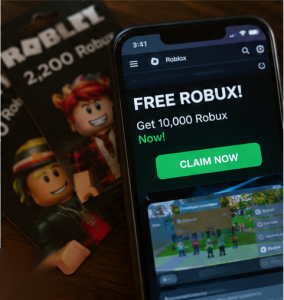
Fake Robux and gaming currency scams promise free Robux, V-Bucks or skins, and they target children because the rewards feel real and valuable.
No free Robux offer from a third party is genuine. The offer is the bait, and the real goal is to steal the account login, personal information or money.
Most work by asking a child to 'log in to claim', which hands their password straight to the scammer, sometimes moving them onto a Discord server first to apply pressure.
Newer scams are harder to spot because AI now produces convincing fake 'proof' videos and fake login pages, so looking real is no longer a sign that something is safe.
One rule protects against almost all of it: real Robux only ever comes from Roblox itself. If your child has already clicked, change the password and check the linked email straight away.
What Are Fake Robux and Gaming Currency Scams?
Fake Robux and gaming currency scams are schemes that promise children free in-game money (Robux on Roblox, V-Bucks on Fortnite, and similar currencies elsewhere) in order to trick them into handing over their account login, personal details, or real money. The ‘free currency' is the bait. It never actually arrives, because it doesn't exist to give.
These scams work because they target something children genuinely want and often can't easily get. In-game currency is real money turned into status, and children frequently have far more desire for it than budget. A scammer offering a shortcut to hundreds of free Robux is offering something a child is primed to want to believe in. That emotional pull, combined with a child's still-developing instinct for what's too good to be true, is what makes these scams so effective.
It's worth knowing that this is high-volume, organised activity, not a few isolated tricksters. Because stolen accounts with rare items have real resale value, scamming children out of game accounts is a genuine money-making operation, run at scale with automated tools. In the Roblox community, the people who steal and resell accounts and rare items are often called ‘beamers', and the act of stealing an account this way is called ‘beaming'. One of their main techniques, sometimes called ‘cookie logging', tricks a child into handing over the hidden login token stored on their device, which can grant access to an account even when two-step verification is switched on.
Are Free Robux Offers Ever Real?
No. There is no legitimate way to get free Robux from a third-party website, app, generator or giveaway. The only place Robux ever comes from is Roblox itself, whether that's buying it directly, a Roblox Premium membership, or Roblox's own official earning routes for creators. Every other ‘free Robux' offer is a scam, without exception.
This is the single most useful thing to teach your child, because it turns a confusing judgement call into a simple rule. They don't have to work out whether a particular site looks trustworthy, or whether a particular video seems convincing. If an offer of free Robux comes from anywhere other than Roblox, it's fake and it's after something, usually their account, their personal details or your money.
How Free Robux Scams Actually Work
Free Robux scams work by getting your child to take an action that hands the scammer something valuable, usually their password, dressed up as a step needed to ‘claim' the reward. The presentation varies, but the mechanism is almost always one of a few things.
The classic version is a fake website. Your child sees an ad, a video, or a message pointing to a site promising free Robux. The site looks convincing, often copying Roblox's branding, and asks them to ‘log in to claim' their reward. The login page is fake. The moment your child types in their username and password, the scammer has their account. Sometimes the site adds a ‘human verification' step or a survey, which harvests more personal data or earns the scammer money per completion.
A second version asks for a different kind of access. Rather than a password, some scams trick a child into running a piece of code or installing a browser extension that steals the hidden login token from their account, which can hand over access even when two-step verification is switched on. These are more technical, but they reach children through the same ‘free Robux' promises.
A third version is purely about money. The site asks for card details to ‘verify' the account or ‘unlock' the Robux, and either charges the card directly or signs the family up to a recurring payment buried in the small print.
Across all of these, the tell is consistent, because at some point a free reward asks your child to give something real (a password, personal details, card information, or access to their device). Legitimate rewards never need that.
How Free Robux Scams Steal Accounts
Most free Robux scams steal accounts through a fake login page. Your child is told to ‘log in to claim' their reward on a site that copies Roblox's branding, and the moment they type in their username and password, the scammer has the account. Some of these pages even check the password against the real Roblox system as it's typed, so they only capture working details.
There are two other routes worth knowing. Some scams trick a child into running a piece of code or installing a browser extension that steals the hidden login token from their account, a technique sometimes called cookie logging, which can hand over access even when two-step verification is switched on. Others skip the account entirely and go straight for money, asking for card details to ‘verify' or ‘unlock' the Robux. The stolen accounts are valuable in their own right, which is why people known as beamers steal and resell accounts with rare items. Whichever route it takes, the entry point is almost always the same, which is a child being tempted to hand over a password or access in exchange for a reward that was never real. If your child has already lost access, our guide on what to do if a gaming account gets hacked walks through recovery.
New Robux Scam Tactics Parents Should Know About
The scams have become noticeably more sophisticated, and a few 2026 tactics are worth understanding because they defeat the old advice of ‘just look out for dodgy-looking sites'.
Website to Discord pipelines. A big shift is that the website is now often just step one. Children are funnelled from a ‘free Robux' site onto a Discord server set up to look like an official event, complete with staff roles, ticket bots and a confident, organised tone. On Discord, scammers can apply pressure in real time, walk a child through the steps, and make the whole thing feel legitimate and supervised. It's a far more effective trap than a static website. Our guide on whether Discord is safe covers how these servers operate.
AI-generated fake proof. Scammers now use AI to produce convincing videos showing the ‘generator working', with fake screen recordings and Robux balances climbing. Searching YouTube or TikTok for free Robux returns piles of these, often with titles claiming they're ‘working in 2026'. The fake proof is designed specifically to overcome a child's doubt.
Real-time phishing pages. Some fake login pages now check the password against the real Roblox system as it's typed, showing a fake error until they capture one that genuinely works. This makes the page feel like the real thing and confirms a working password for the scammer. The UK's National Cyber Security Centre notes that phishing pages like these have become significantly harder to spot, which is why teaching the underlying rule matters more than hoping a child will notice a fake.
Impersonating a friend. With a hacked account, a scammer can message your child's actual friends pretending to be them, sharing the ‘amazing free Robux site' they supposedly just used. A recommendation from a trusted friend lowers everyone's guard, which is exactly why one hacked account leads to several more.
The common thread is that ‘it looks real' and ‘a friend sent it' are no longer reliable signs of safety. That's why the defence has to be a rule, not a vibe.
Why Children Fall for These Scams
Children fall for these scams not because they're foolish, but because the scams are expertly designed to exploit exactly how children think and what they want. Understanding why helps you talk to your child about it without making them feel stupid, which matters, because shame is what stops them telling you when something goes wrong.
Several things are at play. Children want the currency badly and often can't get much of it legitimately, so the offer lands on willing ground. Their instinct for ‘too good to be true' is still developing, so a confident, official-looking offer carries more weight than it would for an adult. Peer influence is powerful, so a scam shared by a friend or repeated across servers feels normal and trustworthy. And scammers deliberately use urgency (‘event ends today', ‘only 50 spots left') to push children into acting before they think.
None of this is a failing on your child's part. Adults fall for sophisticated scams too, and these are built by people who do it for a living. Everything we've read and documented points the same way, which is that children recover from a scam best when a parent reacts with ‘let's sort this out together' rather than ‘how could you be so silly'. Framing it that way keeps your child willing to come to you.
Warning Signs of a Robux or Currency Scam
The warning signs of a Robux or currency scam are usually clear once you know them, and they're worth teaching your child directly so they can spot them without you. Almost every scam shows at least one of these.
- Any promise of free, bonus, or discounted Robux, V-Bucks or items from somewhere other than the official game
- A request to log in on a website that isn't the official platform
- A ‘human verification', survey or task step before you can ‘claim'
- A request for a password, even from someone claiming to be a friend or staff member
- A request to run a code, paste something into the browser, or install an extension or app
- A request for card details to ‘verify' or ‘unlock' a reward
- Urgency and pressure, such as countdowns or limited spots
- Being moved from a website onto a Discord server to ‘complete the process'
- YouTube or TikTok videos showing a generator ‘working'
If your child has used the same password across several accounts, our guide on building a family password system that works is worth a read, since a single stolen password can otherwise unlock far more than just their game.
How to Protect Your Child's Account and Money
Protecting your child's account and money comes down to one memorable rule, a few technical safeguards, and an agreement that they'll always check with you first. Together these stop the overwhelming majority of scams.
Teach the one rule. Real Robux only ever comes from Roblox, just like real money only comes from a bank. Anyone offering free Robux is trying to take something. For younger children, this simple rule works better than any technical explanation. For older children, it's worth explaining the ‘if it asks for your password, it's a scam' test too.
It's also worth putting a few technical safeguards in place.
- Turn on two-step verification on the game account and the email linked to it. This is the single most effective technical protection.
- Remove saved card details from the account and platform, so no purchase can happen without you entering them.
- Use a unique password for the game, not one shared with other accounts.
- Set up parental controls and spending limits, covered in our guide on how to set up parental controls on iPhones, Androids and home devices.
- Agree the ‘show me first' rule: any link, giveaway or website a friend mentions gets shown to you before they click or log in.
For families wanting an extra layer, a security or parental tool can help spot scam links and phishing attempts before a child acts on them. Aura combines parental controls with scam and identity protection, which fits this risk well, and Bark can flag concerning links and messages across apps. Our roundup of the best parental control apps in 2025 compares the options.
What Is the Safest Way for a Child to Get Robux?
The safest way for a child to get Robux is through Roblox directly, either by buying it, through a Roblox Premium membership, or through Roblox's own official programmes for creators who make games and items. These are the only routes that are genuinely safe, because they never involve handing a password or payment details to a third party.
It's worth having this answer ready, because telling a child that every shortcut is a scam works far better when you can also point them at what's allowed. A small regular Robux allowance, or earning it through Premium, removes a lot of the temptation that scammers rely on. Some regulated rewards programmes also exist, but they should only ever be used with your oversight, and the safe test still applies, which is that if something asks for your child's Roblox password, it's a scam.
What to Do If Your Child Clicked a Fake Robux Link
If your child has already fallen for a Robux scam, act quickly but don't panic, and don't make your child feel it was their fault. Fast action limits the damage, and a calm response keeps them willing to tell you the full story.
- Change the password immediately, on the game account and on the email linked to it. If the same password is used elsewhere, change it there too.
- Turn on two-step verification to lock the scammer out, if it isn't already on.
- Check for unauthorised purchases or changes, including spent Robux, traded items or altered account details.
- If card details were entered, contact your bank to stop and dispute any charges, and report to Action Fraud.
- Contact the game's support team to report the scam and ask about recovering a hacked account or stolen items.
- Warn your child's friends if the account may have been used to send the scam on to them.
- Reassure your child. They'll likely feel embarrassed or upset, especially if they lost items they cared about. Make sure they know they aren't in trouble.
If the scam turned out to be a route to account theft more broadly, our guide on what to do if a gaming account gets hacked covers the full recovery process step by step.
Frequently Asked Questions
Can my child get banned for using a free Robux site?
Yes, a child can lose their Roblox account for using free Robux sites, apps or generators. These tools break Roblox’s rules, and they also put the account at risk of being stolen, traded, locked or permanently banned.
That can mean losing Robux, saved items, progress, friends and purchases. If your child has already used a free Robux site, change the password, secure the linked email, turn on two-step verification and check whether anything has been traded or changed.
Are Robux generators safe?
No. Robux generators are not safe, and they do not work. There is no legitimate third-party tool that can generate free Robux. These sites and videos are designed to steal logins, collect personal information, push unsafe downloads or trick children into giving scammers access to their account.
Some Robux generator scams now look convincing because they use fake comments, AI-generated proof, copied Roblox branding or hacked accounts to make the offer seem real. The answer is still the same: if it is not Roblox, it is not a safe way to get Robux.
Should I let my child use a free Robux app?
No. Free Robux apps are not a safe way to get Robux. They usually exist to collect logins, personal data, payment information or device access, and some may encourage unsafe downloads or repeated ad clicks without ever giving your child anything real.
If your child has already used one, delete the app, change the Roblox password, secure the linked email and turn on two-step verification. If you are worried about unsafe downloads, scam links or wider device exposure, a tool like Aura can help with broader family security, identity monitoring and scam protection.
Can parental control apps help stop Robux scams?
Parental control apps cannot block every Robux scam, but they can help reduce the risk, especially when scams spread through messages, links, social apps, Discord, YouTube or a child’s wider device activity.
Tools like Bark can flag concerning messages and activity across apps, while mSpy gives parents broader device-level visibility. For families who also want identity, scam and financial monitoring, Aura may be a stronger fit. You can compare the options in our guide to the best parental control apps.
How do I talk to my child about Robux scams?
Keep the conversation simple and blame-free. Children fall for Robux scams because the scams are designed to look exciting, urgent and believable, especially when they come through games, videos, friends or fake giveaways.
The rule to teach is clear: real Robux only comes from Roblox. If anyone offers free Robux, asks them to log in somewhere else, sends a link, asks for a code, or tells them to keep it secret, they should show you first. Our guide on how to talk to your kids about online safety can help you keep that conversation open without making them feel embarrassed or punished.
What is the safest way for my child to get Robux?
The safest way for your child to get Robux is through Roblox directly, using official purchases, gift cards or a parent-managed account. Avoid third-party websites, generators, giveaway apps, Discord offers, survey links and anything that asks your child to log in outside Roblox.
If your child wants Robux regularly, it can help to set a clear family rule around spending, use gift cards instead of saved card details, and set spending limits through Roblox parental controls. For wider household protection, our guide on building a family password system can also help keep gaming accounts harder to steal.
