


Last Updated on November 20, 2026 by Nick Francis
FAMILY SAFETY · SOCIAL MEDIA
Is Discord Safe for Kids? Risks Every Parent Needs to Know
Discord can give children a place to play games, share interests and keep in touch with friends. It also makes it easy to join unfamiliar communities and receive unwanted contact. If your child wants to use it, understanding the age requirements, privacy settings and limits of parental supervision matters. Here's what parents need to know before saying yes.
What Is Discord?
Discord is a chat platform that lets people talk to each other through text, voice and video, usually inside online communities called servers. It started out as a tool for gamers, and that’s still where most of its activity sits, but it’s grown into something closer to a hybrid of WhatsApp, Reddit and a group voice call all in one app.
What makes Discord different from a more familiar app like WhatsApp is that it isn’t only about people your child already knows. It’s built around joining communities of strangers, by design. That isn’t sinister on its own, and most servers are run perfectly responsibly by the people in them. But it is the thing most parents underestimate when they first hear the name, because nothing about the way Discord is described matches the way they’re used to thinking about messaging apps.
Discord is free to use, with a paid subscription called Nitro that adds extra features.
How Discord Works
Discord works through three main features that, between them, account for most of what your child is doing on the platform: servers, direct messages, and voice chat. Once you can picture each of these, the rest of the platform becomes much easier to follow.
Servers are the heart of Discord. A server is a community with its own channels (sub-rooms inside the server), members and rules. Anyone with a link to a server can usually join it, which means a child can move from a small server with three school friends to a server with 100,000 strangers in the space of one shared invite. Some servers are gaming-focused, some are themed around YouTubers or interests, and some are general chat rooms. The quality, moderation and tone of each one varies wildly.
Direct messages, or DMs, are private one-to-one or group chats. The people involved may have met through a server rather than in person. A private conversation is not necessarily a trusted one, and deleting a message does not remove every possible screenshot or saved copy.
Voice chat happens in server channels or direct calls. Family Center can show some call activity, but it does not provide recordings or let parents listen. A familiar-sounding voice is not proof of identity, especially if a call involves an unexpected request for money or account access.
What Is Discord Used For?
Discord is used most often for talking to friends while gaming, but it’s increasingly used for plenty of non-gaming things too, including study groups, fandom communities, friendship circles, hobby spaces, school clubs, and even some university societies. For many teenagers, Discord has become the main way they communicate with friends, in much the same way previous generations used MSN, then Facebook chat, then WhatsApp.
The crossover with gaming is still where most parents first encounter it. A child might play Fortnite, Minecraft, Valorant or Roblox and use Discord on a second screen to talk to friends while they play. A conversation might start inside a game and continue on Discord afterwards, which is part of why Discord can feel hard to keep track of from the outside.
Children are drawn to Discord for reasons that, on reflection, are pretty understandable. It feels private without feeling lonely. It’s where their friends are. It works the way they expect a modern app to work, with voice, video, group chats and shared servers all in one place. For a teenager whose social life is partly online, being told they can’t use Discord can feel like being told they can’t use the phone, because for them, it functions like one. That’s worth understanding before deciding what to do about it, because the social pull is genuine and won’t disappear just because a parent wants it to.
Part of why Discord doesn’t quite fit the shape of any other app you might know is that it sits somewhere between social media and private messenger. It isn’t quite TikTok and it isn’t quite WhatsApp. That in-between space is exactly why it’s become so popular with young people.
Is Discord Safe?
Discord can be appropriate for some teenagers, but its safety depends on the communities they join, their settings and how other people behave. A small server with school friends presents different risks from a large public community where strangers can make contact. Neither setup guarantees safety.
Discord requires users to be at least 13, with a higher minimum age in some countries. Check your country’s requirement before creating an account. Parental supervision does not make an underage account eligible.
For eligible teenagers, review contact settings, server membership and Family Center together. Some safety defaults and age-check requirements vary by region. In the UK, Discord applies teen safety defaults unless an account is confirmed as adult; do not assume every country or account has an identical setup.
Ask what your child enjoys about Discord as well as what worries them. Agree suitable communities and boundaries, and explain that they can leave an uncomfortable conversation or ask for help without having to justify it.
Our guide to the hidden dangers of social media covers related risks across other platforms.
What Are the Risks of Discord for Children?
The risks of Discord for children fall into a handful of specific categories, and understanding each one separately makes the platform much less overwhelming to think about. None of these things makes Discord uniquely dangerous. They do make it different from the apps you might already be familiar with, and that difference is usually what’s sitting underneath the unease.
Stranger contact through servers
Stranger contact is the most common risk on Discord, and the one most parents are right to worry about first. Because servers are built around shared interests rather than existing relationships, children frequently end up in chats with adults they’ve never met. In a server with 50,000 members, your child might be the only 13-year-old in a room full of adults. Most of those adults are harmless. A small number are not, and the platform’s structure makes it easier for them to start a conversation than on more closed apps.
Who can contact your child depends on their settings, age and region. Review server-member direct messages, message requests and friend requests together. Use the correct date of birth and do not bypass age checks to unlock features.
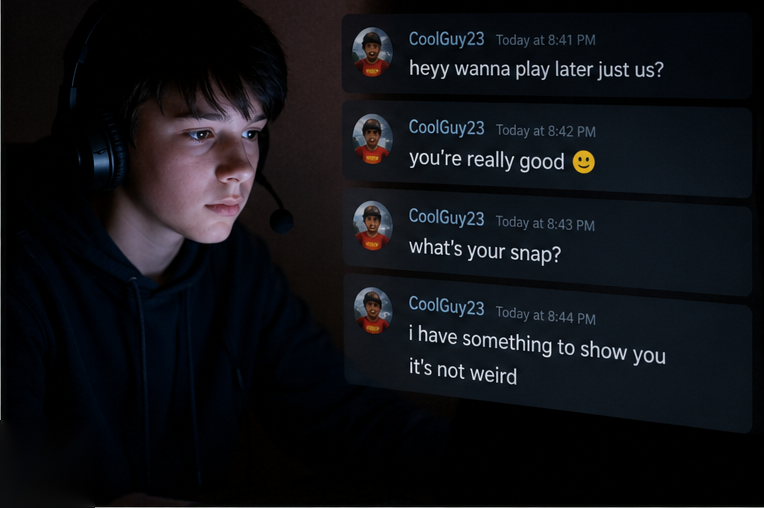
Off-platform pressure
Off-platform pressure is when someone your child meets on Discord suggests moving the conversation to another app, often Snapchat, Telegram, Signal or a private gaming server. This is one of the patterns most consistently flagged by online safety organisations as a potential grooming step, because it moves the conversation somewhere harder for parents to see and where messages often disappear automatically.
Off-platform pressure doesn’t always mean grooming. Plenty of teenagers move conversations off Discord simply because they prefer the features of another app, or because their friends are on Snapchat. But when someone your child has never met in person starts pushing for that move quickly, or insists on it after only a few conversations, it’s worth paying attention to. It’s also worth your child knowing that this pattern exists, so they can recognise it themselves rather than relying on you to spot it for them.
Voice chat and limited parental visibility
Voice conversations can move quickly, making pressure or requests for personal information harder to pause and think through. Family Center can show some recent call activity, but it cannot tell you what was said. Agree that your child can leave, block someone and ask for help whenever a conversation feels uncomfortable.
Harmful and extremist content
Discord servers can host explicit, extremist or harmful content, and some are deliberately built to expose children to material they shouldn’t see. Discord has been linked publicly to incidents involving radicalisation, self-harm communities, eating disorder content and sexual extortion rings.
This doesn’t mean every server is dangerous. The vast majority are fine. But the platform’s open server discovery, combined with link-sharing across gaming and social media, means a child can land in a harmful server with very little effort. The teen-by-default content filter helps, but it isn’t a guarantee.
AI-driven manipulation and voice cloning
AI-driven risk is the category that’s shifted most in the last two years, and the one many parents haven’t yet caught up with. Predators and scammers are now using AI to write more convincing messages at scale, to clone voices in real time during voice chat, to generate fake images and to mimic friends or family members.
The practical implication is that some of the old warning signs (poor grammar, generic phrasing, scripts that don’t quite fit) have become much less reliable. A message that looks like it’s from a teenager their own age might not be. A voice that sounds like a friend, in a Discord call, might not be. Our guides on AI chatbots and the hidden dangers and what to do if your child is talking to a chatbot cover the wider picture of how AI is changing what children are exposed to online.
Help your child recognise requests for secrecy, money or account access, and make sure they can ask you for help. Combine that conversation with privacy settings and independent checks of unexpected requests.
Financial scams and account theft
Financial scams on Discord typically target gaming accounts, in-game currency, gift cards or Discord’s own paid features. Common patterns include fake Nitro giveaways, free Robux scams that ask for account login details, fake gaming developers offering early access, and impersonation of a friend asking for help. Some scams are simple enough to spot. Others are sophisticated and tailored, especially with AI tools now able to mimic a real friend’s writing style.
The financial side of Discord also includes legitimate spending in the Discord Shop and on Nitro subscriptions, which can mount up quickly without parents noticing. Family Center now shows total purchases over the last 7 days, which helps catch this earlier than it used to be caught.
Discord Red Flags Parents Should Not Ignore
Discord red flags parents should not ignore tend to fall into a few clear patterns, usually around secrecy, sudden new contacts, and conversations being moved off the platform. The signs below aren’t meant to make every late-night gaming session feel sinister. They’re the patterns that, when they appear together or escalate, tend to mean something is worth a calm conversation.
Signs worth paying attention to:
- Suddenly hiding the screen when you walk into the room, more than typical teenage privacy
- A new server, friend or contact your child seems unwilling to talk about
- Conversations that appear to have moved off Discord to Snapchat, Telegram or text
- Gifts, gaming currency or items appearing without an obvious source
- Late-night voice chat with people they haven’t met in person
- Distress or withdrawal after time spent online
- A second account they haven’t told you about
- A contact who pressures your child for secrecy, money, sexual content or account access, or makes them feel responsible for an adult’s feelings
- Unexpected charges or new Discord Shop purchases you didn’t approve
If your child has started using Discord alongside other apps you can’t easily see, our guide to finding hidden apps on a child’s phone is a useful companion.
Any one of these in isolation isn’t necessarily a problem. A pattern of several together is what’s worth taking seriously, and taking it seriously starts with a conversation, not a confiscation.
What Discord Family Center Shows Parents
Discord Family Center shows parents a 7-day summary of their child’s activity, and it’s worth knowing exactly what’s in that summary because most parents assume it shows more than it actually does.
Once your child has linked you as a guardian, Family Center shows:
- Recently added friends, including display names and avatars
- Servers your child has joined in the last 7 days
- Users your child has messaged or called, including names and times
- Top five users and servers by activity
- Total voice and video call minutes
- Active servers
- Total purchases from Discord Shop and Nitro in the last 7 days
- A weekly email summary sent to your registered address
Activity is only available after your teenager accepts the connection. Discord requires adults using certain guardian-managed settings, including message requests, to confirm an adult age group. Eligibility and available controls can vary by region. Parents cannot directly remove their teenager’s friends or servers through Family Center.
What Discord Family Center Does Not Show
Discord Family Center does not show parents the content of any conversations, and this is the part most families are surprised by. It’s worth being completely clear about what’s not visible to you, because the gap between what parents expect and what Family Center actually offers is often where false reassurance can creep in.
Family Center does not show:
- The content of any messages your child sends or receives
- The content of any voice or video calls
- Anything older than 7 days
- Activity from before you linked the account
- Anything at all if your child disconnects you, which they can do at any time
The honest framing of Family Center is that it’s closer to teen oversight than full parental control. It’s designed to support conversations between you and your child, not replace them. That’s a deliberate choice on Discord’s part, and there are reasonable arguments for and against it. It’s also the reality of what you’re working with, which is why so many families pair it with other tools. Our guide to parental monitoring apps versus stalkerware is also worth a read if you’re trying to work out what’s appropriate to use alongside Family Center and what crosses a line.
What To Do If Something Has Already Happened
Start with your child’s immediate safety and reassurance. Tell them they are not in trouble for asking for help. Where it is safe, retain usernames, message links and relevant non-explicit evidence before blocking or reporting. Do not download, copy or forward sexual images of a child. Use emergency services if someone is in immediate danger.
The right steps depend a little on what’s happened. Here are the most common scenarios.
If a stranger has been contacting your child
Save relevant non-explicit messages and account details, including the username and any servers you share with that person. Use the block and report functions inside Discord. If the person has been asking for photos, suggesting they meet up in person, or showing any sexual interest in your child, report to CEOP immediately. You don’t need to be sure it’s grooming to report it.
If your child has been groomed or pressured
Stay calm with your child, even if what they’re telling you is alarming. They may already be feeling shame, fear or confusion, and the way you respond shapes whether they tell you anything else. Don’t delete the conversation. Retain relevant non-explicit evidence, then report suspected sexual abuse or exploitation to CEOP. Speak to your child’s designated safeguarding lead at school if relevant. The NSPCC helpline can support parents in this situation.
If your child has fallen for a scam
If a Discord scam has taken money, account details or gaming currency from your child, act quickly. Change the password on any accounts that were compromised, including the email address linked to those accounts. Enable two-factor authentication on Discord and on any gaming accounts. Contact the relevant game’s support team to report theft. If real money has been taken, contact your bank promptly and report through your country’s official fraud-reporting or police service.
If your child has sent something they regret
If your child has sent intimate images, personal information or anything else they now regret, reassure them first. It happens more often than parents realise, and a panicked reaction often makes things harder. For intimate images, our guide on what to do if your teen is targeted by sextortion walks through the specific steps. The Internet Watch Foundation’s Report Remove tool can help get intimate images of under-18s removed from the internet. The recipient should be blocked and reported on Discord. Report suspected sexual abuse or exploitation through the appropriate child-protection service, regardless of the claimed age of the account.
If your child’s Discord account has been hacked
If your child’s Discord account has been hacked, the priority is regaining control before the hacker can use it to scam friends or post harmful content. Reset the password if you still have email access. Enable two-factor authentication. Contact Discord support to report the compromise. Check whether any other accounts linked to the same email have been affected, and change those passwords too. Warn your child’s friends, because hacked accounts are often used to send scam links to contacts.
General principles for any situation
Across all of these, a few things hold true.
- Preserve evidence where safe. Keep usernames, server details, message links and relevant non-explicit screenshots. Do not copy or forward sexual images of a child.
- Don’t delete anything. Even if your instinct is to wipe it, the evidence matters for any report.
- Block and report inside Discord. Discord’s Trust and Safety team handles these reports and can act on accounts and content.
- Speak to your child without blame. Whatever has happened, they may be embarrassed, frightened, or convinced it was their fault. It almost never is. The way they’re treated in this conversation will shape whether they come to you the next time, so the goal is for them to feel safer, not smaller.
- Get support for yourself too. Internet Matters, the NSPCC and the Lucy Faithfull Foundation all have helplines for parents in this situation. You don’t have to handle this on your own, and a quick call doesn’t commit you to anything.
Most situations don’t need every one of these steps. But knowing they exist makes the first hour feel less like freefall. Your calm in that first hour is the single most useful thing you can offer your child.
How to Keep Your Children Safe on Discord
Keeping your children safe on Discord comes down to three things working together: turning on the right settings, agreeing the right rules, and adding the right tools where they help. None of these on its own is enough. All three of them, combined with open conversation, is what actually works.
Discord Parental Controls: Settings to Check Today
Discord parental controls settings to check today include the direct messages filter, friend request restrictions, who can send DMs, and the list of servers your child has joined. Working through these together with your child tends to land better than going behind their back to change them. You get the same result, with their trust intact, which is what you actually need them to bring to you when something feels off. Our guide on how to talk to your kids about online safety covers the conversation side of this in more detail, particularly the balance between monitoring and trust.
- Review content filters. Keep sensitive-content protections enabled and explain that filters can miss harmful material.
- Limit friend requests. Disable requests from groups your child does not need to hear from. Friends of friends can still include strangers.
- Review server-member direct messages. Turn them off where contact from unknown members is unnecessary.
- Check message requests. Review how non-friend messages are handled; menu labels and available choices vary by age and region.
- Link Family Center together. Follow the current in-app instructions and confirm the intended account is connected.
- Review servers and profile details. Remove unnecessary personal information and discuss who belongs to each community.
For device-level settings that sit underneath Discord and apply across other apps too, our walkthrough on how to set up parental controls on iPhones, Androids and home devices covers the wider setup most families need to do alongside this.
Setting Rules and Boundaries
Setting rules and boundaries around Discord works better when they’re agreed with your child rather than imposed on them, and when they’re realistic enough to stick to. A rule that gets broken on day three teaches your child to break rules. A rule that’s been talked through, understood and agreed has a much better chance of holding.
Useful rules to consider:
- Which devices Discord can be used on, and which it can’t (no Discord in bedrooms overnight is a common one)
- Time-of-day boundaries, including no voice chat after a certain hour
- A rule that voice chat with anyone they haven’t met in person needs to be talked about first
- A rule that any request to move conversations off Discord gets flagged to you, no questions asked
- An agreement that Family Center stays linked, and that if it gets disconnected, that’s a conversation rather than a fight
- Clarity on what your child should do if something happens, including knowing they won’t lose Discord altogether for telling you
Our guide on how to create healthy family technology rules goes deeper into building agreements that actually stick. The most important rule of all is that they can come to you about anything they see on Discord without being punished for it. If the only way to keep using Discord is to hide things, they’ll hide things. If telling you is safe, they’ll tell you.
When Parental Control Apps Can Help
Device-level controls can help with app access and time limits, but do not assume they reveal private Discord messages, deleted content or call recordings. Features vary by device and permissions, and no tool makes an underage account appropriate.
Start with Discord’s free controls and a conversation. If another tool would address a specific concern, compare its current capabilities, privacy practices and installation requirements in our parental control app guide. Be open about supervision and avoid tools that require weakening device security.
Should Parents Ban Discord or Set Boundaries?
Restrict access if your child is below the applicable minimum age, faces an immediate safety concern or cannot currently use Discord within workable boundaries. For eligible teenagers, consider what the app adds to their friendships as well as the risks.
Explain your decision, agree when to review it and help them keep in touch with trusted friends in other ways if access needs to stop. A child should be able to disclose a problem without assuming they will automatically be punished for it.
Settings and supervision support that relationship. They cannot replace it. What matters is that your child knows how to leave an uncomfortable interaction, who can help and that you will take their concern seriously.
Frequently Asked Questions
Is Discord dangerous?
Discord has risks involving unwanted contact, harmful content, scams and pressure to move conversations elsewhere. Settings and suitable communities can reduce exposure, but cannot guarantee safety. Children must meet the minimum age for their country.
How do I check if a Discord link is safe?
To check if a Discord link is safe, treat any unexpected link with caution, especially shortened links or links to download something, particularly when shared by someone your child doesn’t know well. Discord is sometimes used to share phishing links targeting gaming accounts, of the kind covered in our guide on how fake Robux and gaming currency scams work. If a link looks suspicious, don’t click it. You can verify links by hovering to see where they actually lead, or by checking the domain on a service like VirusTotal before opening.
Should I delete Discord from my child's phone?
Restrict access if your child is below the applicable minimum age or there is an immediate safety concern. For eligible teenagers, review their experience, settings and boundaries together. Explain any restriction and when you will revisit it.
What should I do if a stranger has contacted my child on Discord?
If a stranger has contacted your child on Discord, prioritise their safety, retain relevant non-explicit evidence where safe, then block and report the account. Do not copy or forward sexual images of a child. If the person asked for photos, suggested meeting, or showed any sexual interest, report to CEOP in the UK, or the NCMEC CyberTipline in the US. Our guide on what to do if a stranger contacts your child while gaming walks through every step.
What is a Discord server?
A Discord server is a private or public space where people gather to chat by text, voice or video, usually organised around a shared interest like a game, a school group or a fandom. Anyone can create one for free, and they can be invite-only or open for anyone to join. The thing for parents to know is that large public servers can put your child in the same space as thousands of strangers, whereas a small private server of real-life friends is much lower risk. Encouraging your child to stick to private servers with people they actually know is one of the simplest safety steps.
What are free Discord Nitro scams?
Fake Nitro offers can lead to phishing pages that steal login details or request malicious downloads. Genuine gifts and promotions also exist, so the word ‘free’ alone does not establish a scam. Open Discord independently to check an offer and never enter credentials through an unexpected message link or scan a login QR code at someone else’s request.
Should my child only use private Discord servers?
A small invite-only server with known friends can reduce exposure to strangers, but it does not remove risks such as bullying, account compromise or harmful sharing. Agree suitable communities, review settings and keep an open route for asking for help.
Related Reviews and Guides

Social Media Ban for Under-16s: Everything Parents Need to Know
Understand the rules, affected apps and practical steps for families.
Read Article
How to Create Family Technology Rules (With No Kickback)
Agree realistic boundaries for devices, screen time and everyday family life.
Read Article
How to Use Built-In Parental Controls on Social Media
Set up free privacy, contact and screen-time controls, and understand their limits.
Read Article